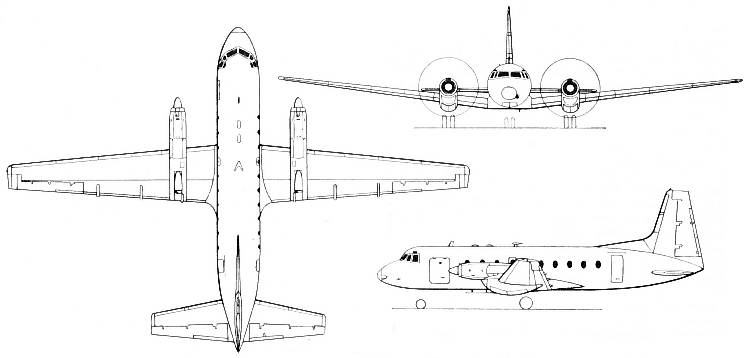
Avro designed the 748 in a bid to re-enter the civil market in the 1950s in anticipation of a decline in its military aircraft business (following Britain's famous 1957 Defense White paper).
Surfacing as the Avro 748 in 1958, the project became part of the Hawker Siddeley group when it formed in 1959 with the merger of several British aviation companies, including Armstrong Whitworth, Avro, Blackburn, De Havilland, Folland, Gloster, and Hawker. From July 1 1963 the separate identities disappeared.
The new aircraft made a successful maiden flight on June 24 1960, and four prototype aircraft (two for static testing) were built. The first production Series 1 flew on August 30 1961.
Series 1 production aircraft were powered by two 1400kW (1880ehp) Dart RDa.6 Mk 514 turboprops, and the first entered service in December 1961 with Skyways Airways. Only 20 (+4 in India) Series 1 were built however, as by that time the improved Series 2 was already flying.
The Series 2, in its 2, 2A and 2B variants, was the most successful of the line, the first flying on November 6 1961. The Series 2 differed from the 1 in having higher weights and more powerful engines. The Series 2B appeared in 1977, offering a range of aerodynamic and other improvements, including an increased wing span. Many Series 2A and 2B were equipped with a large forward fuselage freight door.
The most advanced 748 variant, the Super 748, was an improved version of the 2B and made its first flight in July 1984. Incorporating the improvements of the 2B, it also featured a modernised flight deck, improved efficiency and hush kitted Dart engines, and new galley and internal fittings.
Hawker Siddeley, where the 748 was known as the HS-748, was merged into British Aerospace and from January 1 1978 the Hawker Siddeley name disappeared. Production of the aircraft type, now the BAe-748, ended in 1988 with the last flying that December (with delivery the following month).
The Indian Ministry of Defence had expressed an early interest in the 748 which resulted in an agreement to assemble and build the aircraft under licence. The first four aircraft, Series 1, were built by Kanpur (Indian Air Force Manufacturing Depot), with the first flight made on November 1 1961. Due to a poor production rate, the production was taken over from the fifth aircraft by Hindustan as the HAL-748, who first produced the Series 2 and later the Series 2M with the front fuselage freight door. The last one was delivered in September 1984, to the Indian Air Force.
A special military variant with a rear loading ramp and a "kneeling" undercarriage was the HS-780 (HS-748MF) which was known in British military service as the Andover C1. The standard HS-748 was named the Andover CC2. Later some C1s were converted for photo duties as the C1(PR) and radar calibration duties as the E3 and E3A. A few ex British and New Zealand military C1s entered commercial service.
Production ended in 1988 by which time 382 had been built, including 89 assembled in India, comprising 24 Srs1, 192 Srs2, 101 Srs2B and Super 748, and 31 Andover C1.